

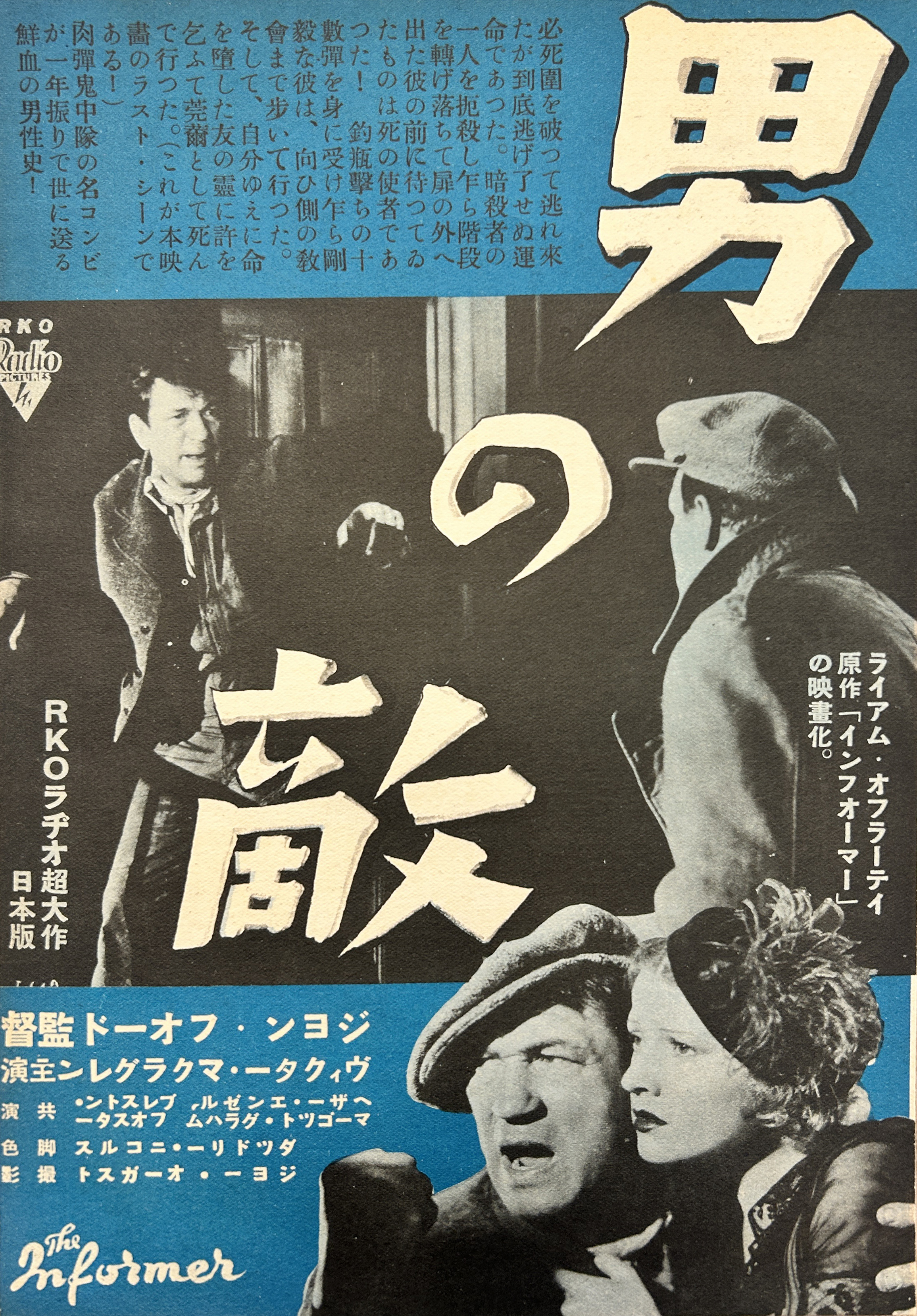
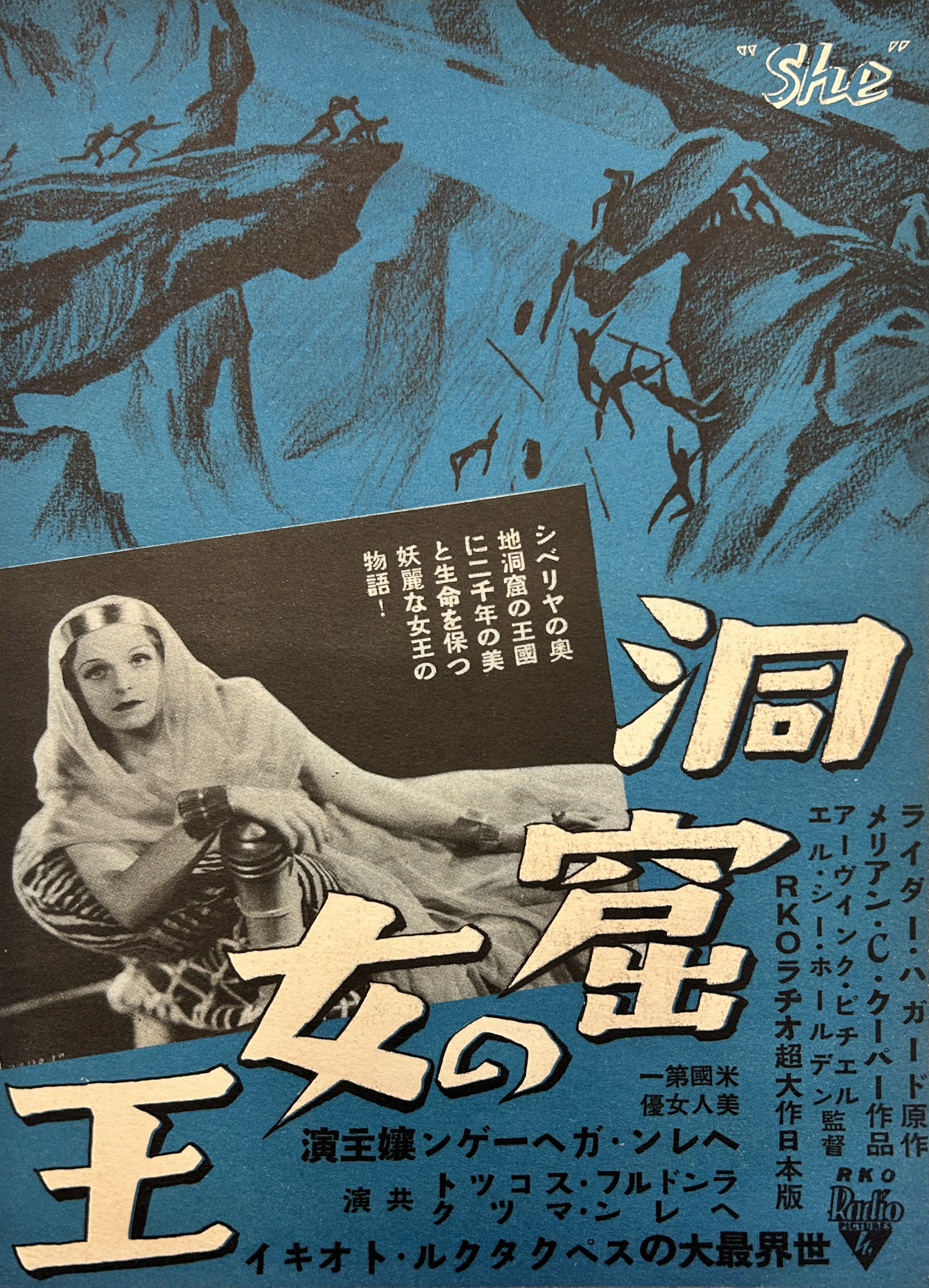
The Informer 1935 Japanese B5 Chirashi Flyer 2-Sided
This is a Japanese B5 Chirashi Flyer (7" x 10.25" flat & 2-sided) for the 1935 American classic film, The Informer.
The Informer is a 1935 American drama thriller film directed and produced by John Ford, adapted by Dudley Nichols from the 1925 novel of the same title by Irish novelist Liam O'Flaherty. Set in 1922, the plot concerns the underside of the Irish War of Independence and centers on a disgraced Republican man, played by Victor McLaglen, who anonymously informs on his former comrades and spirals into guilt as his treachery becomes known. Heather Angel, Preston Foster, Margot Grahame, Wallace Ford, Una O'Connor and J. M. Kerrigan co-star. The novel had previously been adapted for a British film of the same name in 1929.
Along with Mutiny on the Bounty, The Informer was a big contender at the 8th Academy Awards, competing directly in all six categories they were nominated for (though Mutinygot eight nominations in total, given its three Best Actor nominations). The Informer won four Oscars: Best Director for Ford, Best Actor for McLaglen, Best Writing Screenplayfor Nichols, and Best Score for Max Steiner.
In 2018, the film was selected for preservation in the United States National Film Registry by the Library of Congress as being "culturally, historically, or aesthetically significant.
SIDE 2:
The flip side advertises the 1935 adventure-fantasy film She, a 1935 American adventure film produced by Merian C. Cooper. It is based on the 1887 novel of the same name by H. Rider Haggard. A man named Leo Vincey travels with his friend and the daughter of a guide to a mysterious place in Northern Siberia, where his ancestor reported finding the secret to immortality. They discover a lost world where a woman named She Who Must Be Obeyed - known as "She" - rules over an exotic civilization.
The film stars Helen Gahagan, Randolph Scott and Nigel Bruce. Cooper originally wanted to film She in color, but switched to black-and-white after last-minute budget cuts.
The ancient civilization of Kor is depicted in an Art Deco style, combined with influences from Egyptian, Greek, and Mayan art. Special effects were performed through the use of miniatures and matte paintings, along with other techniques. Max Steiner, who composed the score, considered it one of his greatest works. Ruth Rose adapted the story for the screen.
At its initial release in 1935, it lost money, but was more popular in 1949 when it was billed with The Last Days of Pompeii. Reception in 1935 praised the film's spectacle, but found the plot slow and uninteresting. Reviews from the end of the 20th century agreed that the sets, costumes, and special effects were impressive, but found the acting lacking. The film had two DVD releases in the 2000s, including a version colorized by Ray Harryhausen.