
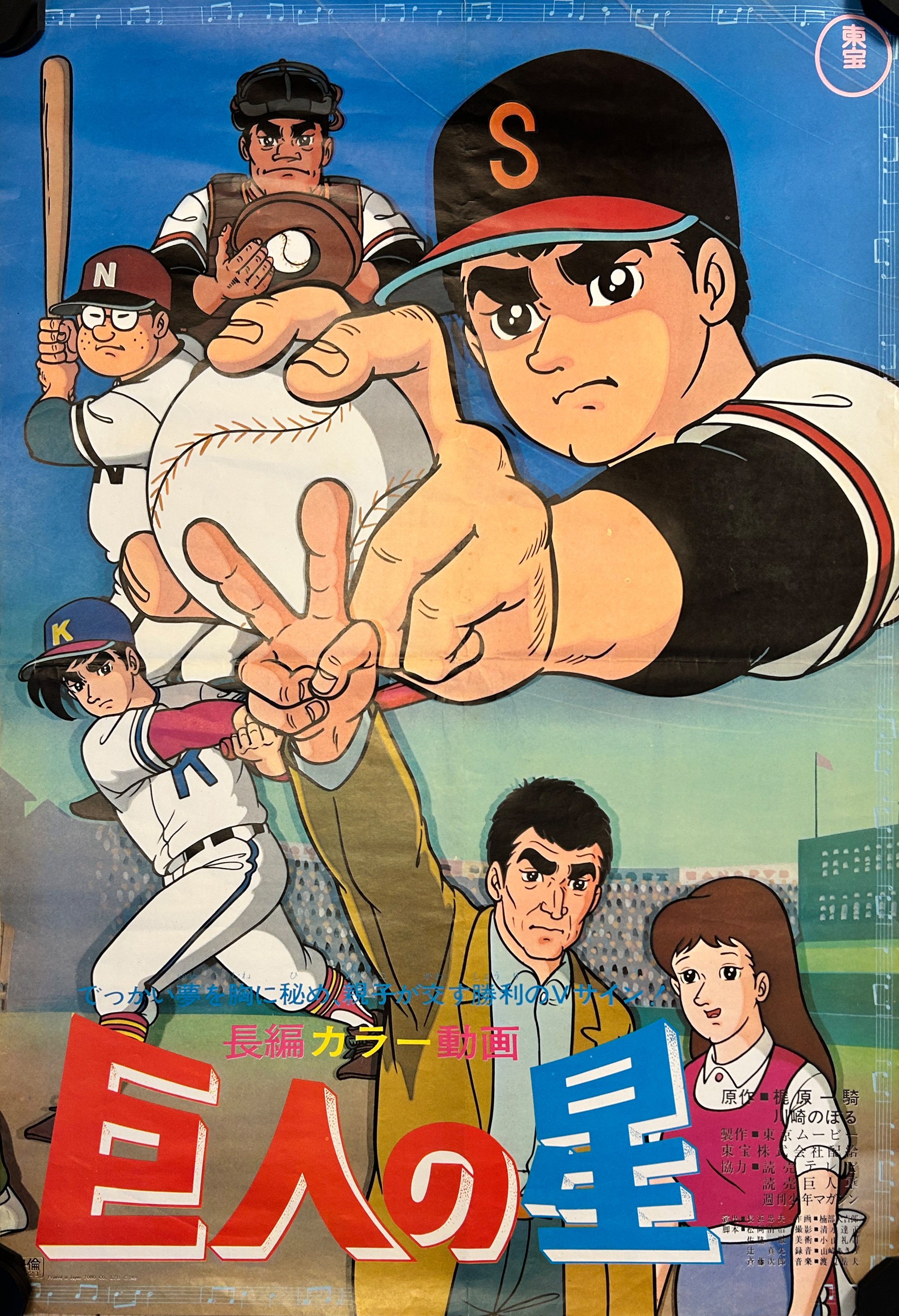
New Star of the Giants 1977 Japanese B2 Poster
This is a Japanese B2 Poster (20.3" x 28.7") for the 1977 Japanese animated film Shin Kyojin no Hoshi (New Star of the Giants) released in Japan on December 1, 1977. It is the sixth film in the Star of the Giants franchise, focusing on Hyūma Hoshi’s dramatic return from a career-ending injury to become a batter, reediting the early episodes of the Shin Kyojin no Hoshi television series.
The series is based on the popular baseball manga and anime series written by Ikki Kajiwara and illustrated by Noboru Kawasaki. It was serialized in Kodansha's Weekly Shōnen Magazine from 1966 to 1971. It is about the actual baseball team Yomiuri Giants using fictional characters.
The Star of the Giants (Kyojin no Hoshi) is widely recognized as the first sports-themed anime series, premiering in 1968 and continuing its significant cultural impact through the late 1960s. The "Bloody Final" likely refers to the "Blood-dyed Ball Incident" (Chizome no Ball), a pivotal plot point featured in the 1969 movie Go, Go, Hyuma.
It popularized the spokon (sports-guts) subgenre, characterized by grueling training, intense rivalries, and dramatic "miracle" techniques like the "Big League Ball". Famous Japanese baseball players, such as Ichiro Suzuki, cited the series as a reference for their own rigorous childhood training.
The series influenced subsequent manga and anime creators like Naoki Urasawa and Masami Kurumada, and even impacted the fighting game genre (e.g., Street Fighter).
It was one of the first anime to utilize xerography, which allowed for a "rougher" and more organic drawing style compared to the smooth, simple, or rounded styles of earlier TV anime.The series also defined the visual language of sports anime by focusing on over-the-top, dramatic moments. It famously featured exaggerated"deformed" shots, such as the ball seeming to hang in the air for several seconds while the batter waits to swing and visual speed lines.
During intense, emotional scenes or high-speed action, the animation would often switch to abstract or highly stylized backgrounds, which foreshadowed techniques later used by anime directors like Osamu Dezaki.